

Did Bryan Johnson Clone Himself As A Baby?
He sure wants the internet to think so

“I just cloned myself...as a newborn. With this clone, I can: become my own blood boy”
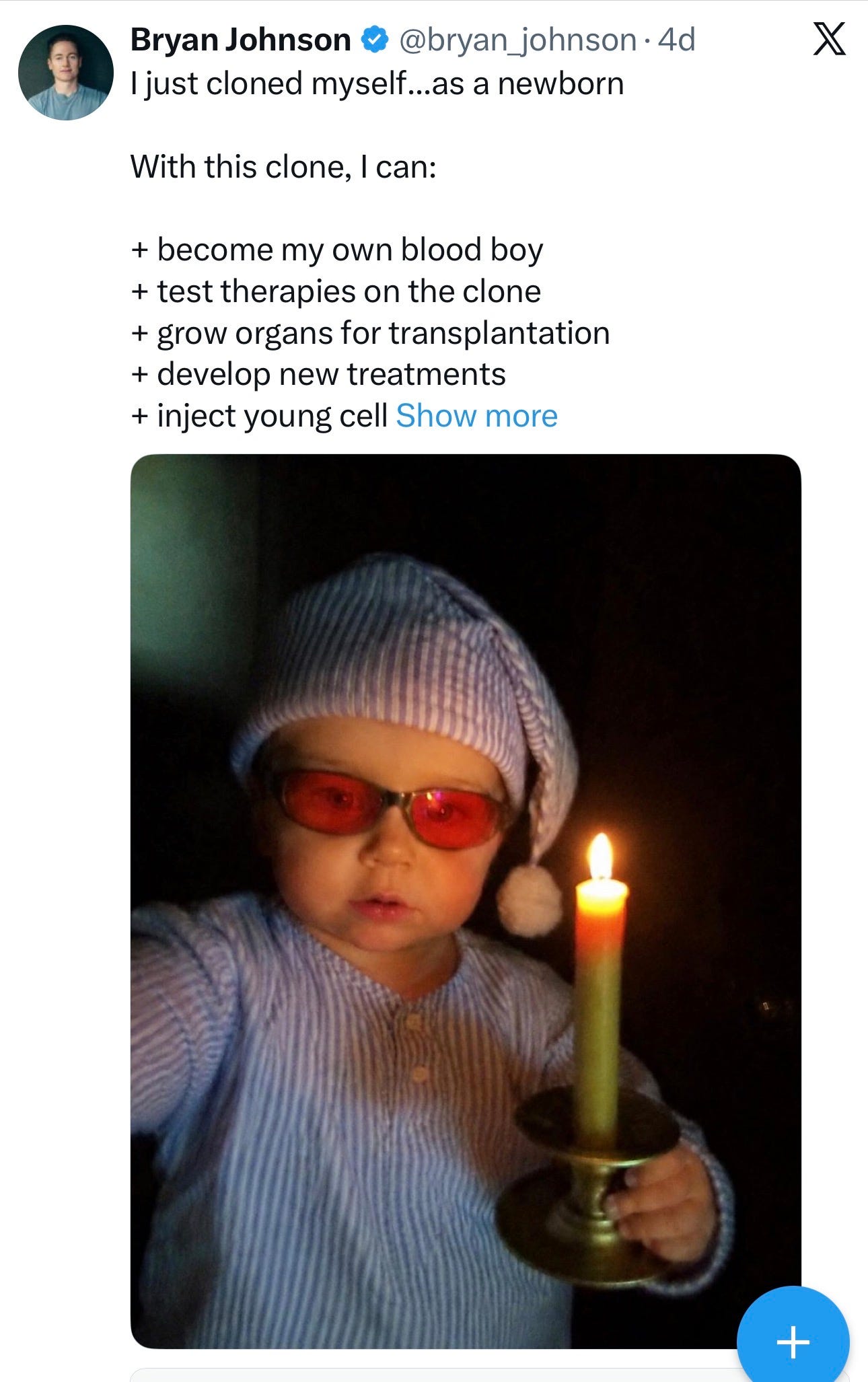
Longevity bro and all around weird rich guy, Bryan Johnson recently tweeted:
“I just cloned myself...as a newborn
With this clone, I can:
+ become my own blood boy
+ test therapies on the clone
+ grow organs for transplantation
+ develop new treatments
+ inject young cells”
Before expanding the tweet text, audiences see an AI-generated hyperrealistic image of a baby wearing uncomfortable seersucker pajamas and sunglasses and holding a lit candle.
Later in the tweet, he writes:
“This may be scary to some people…a dystopian future. But, for others, they will see it as the inevitable future of health.”
Well, yes Bryan, is does sound like a dystopian nightmare where ultra-rich, ultra-self-interested doofuses can clone baby versions of themselves to have an endless supply of blood and organs.
Good catch.
Does the idea of cloning humans for harvesting organs sound familiar?
Maybe you saw The Island in 2005 - an extremely over-budget, action packed sci-fi thriller starring Scarlett Johansson and Ewan MacGregor. The stars escape from a secret facility creating clones and isolating them for life from the rest of the world so that they can serve as organ farms for wealthy, powerful people. The movie flopped, so maybe you didn’t.

Or maybe you saw 1979’s Parts: The Clonus Horror - a the much less expensive film with a similar plot, where the stars escape from a secret facility creating clones and isolating them for life from the rest of the world so that they can serve as organ farms for wealthy, powerful people. (The makers of Parts sued and Dreamworks paid to settle the case over the similarities). In 1997, Parts was introduced to younger audiences on the comedy robot movie show Mystery Science Theater 3000.

There are no heart-warming stories about cloning humans for organ transplantation or to be permanent blood donors. There are no creative sci-fi workarounds that don’t lead to horror plots. It’s weird that Johnson seems keen to self-identify a sci-fi villain.
Johnson, an already eccentric character in the longevity movement, spells out his villain origin story for us:
After blaming his abdominal issues on stress and lifestyle, Johnson has been diagnosed with autoimmune gastritis, where his immune system doesn’t recognize his stomach lining. The disease is notoriously difficult to treat. In the tweet, Johnson says
“getting diagnosed with an incurable disease is one of the best things that has happened to me in a long time. It’s opened up a frontier of new paths to repair and strengthen the body. This is the first example.”
The Clone Hype Works
Cloning claims generate hype.
Dolly the Sheep made her mark in 1996. Announcement of the first cloned mammal shocked the world and invigorated an era of ethical, legal, and social debates on cloning.
However, there are also those who developed elaborate hoaxes, capitalizing on cloning fears and excitement.
In 2002, The Raelian Movement claimed to have cloned a human, leading to the live birth of a girl named Eve. The story generated massive hype for the company they worked with Clonaid. However, evidence was never presented that verified the claim.
Between 2004 and 2006, South Korean researcher Hwang Woo-suk was found to have falsified claims that he cloned human embryonic stem cells. His data was fabricated.
Johnson knows that claiming he’s cloned himself “as a newborn” paired with a picture of a baby sure sounds like he took his cloned cells, had them made into an embryo, and then had them implanted in some lucky lady’s uterus, resulting in a live birth of an actual, crying human baby clone.
This scenario is “reproductive cloning” - something that ethicists and international bodies have squarely opposed for more than 20 years.
Johnson’s Longevity Misadventures
Johnson is notorious for spending millions of dollars per year investing in his own youth. In 2023, he gained notoriety for engaging in a three way plasma exchange with his 17-year-old son and 70-year-old father. He’d previously received “young blood” plasma transfusions (AKA heterochronic parabiosis) from anonymous donors who he screened for body mass, lifestyle, and freedom from diseases. In 2019, the FDA cautioned people against the practice and dubious claims about its efficacy. Johnson didn’t give up young blood transfusions until 2025, when he finally accepted what scientists and doctors had long said - there were no measurable health benefits.
He has now “upgraded to total plasma exchange:” having his blood removed, plasma separated, and replaced with 5% albumin and IVIG. Therapeutic plasma exchange (TPE) is indicated in several autoimmune conditions with acute flares of antibodies, like Guillain-Barré syndrome, systemic lupus, and myasthenia gravis. Recently diagnosed with autoimmune gastritis, presumably this is Johnson’s reason for switching, although autoimmune gastritis isn’t the kind of condition where this treatment makes sense. He’s framed is as an “upgrade.” Though I wouldn’t say switching from a completely pointless intervention to an evidence backed intervention that’s pointless for you specifically is any kind of improvement. As a physician who gives patients both albumin and IVIG, I can’t begin to describe how outrageous this sounds. TPE for a medical indication can reduce the patient’s out of pocket cost. But a single session of TPE for therapy for wellness or longevity costs between $5,000 and $15,000 per session. A multi-session package? Upwards of $40,000 to $50,000.
All Publicity is Good Publicity
Given Johnson’s eccentric approach to living forever, it isn’t a huge leap that this guy would consider himself above any ethical norms about the reproduction of human life.
The whole tweet is a publicity stunt and it worked.
Media outlets fell over themselves to cover the story, putting Johnson in the headlines for sounding like a Norman Osborn/Green Goblin rich-mad-scientist wannabe.


I hadn’t heard the story, but came across Kier Adrian Gray’s note: “We have to make this illegal if it isn’t already.”
I knew the headline couldn’t be true.
I’ve got more to say on the legality question, but first, we gotta move past the headlines to figure out how worried we should be.
Is there a Baby Bryan?
For what it’s worth, despite his provocative language and gross AI generated baby image, Bryan Johnson did not make a newborn baby clone to use his own personal blood and organ bank. At most, he’s referring to a clump of pluripotent stem cells in a test tube, or as he says, a petri dish.
What he goes on to describe in the tweet is a form of therapeutic cloning (cloning techniques for biomedical research), not reproductive cloning (cloning to create living humans).
There is no Baby Bryan. Not really.
“This baby-bryan lives in a petri dish for now.”
The rest of the tweet text gets into the clump of cells Johnson is referring to:
“Clinical trials are already using this technology to restore dopamine neurons for Parkinson’s, heart health and eyesight.
The process
> blood draw
> my cells were extracted
> yamanaka factors applied
> reset epigenetic age
> restoring them to an embryonic-like state
Why?
> these cells are now pluripotent
> can be differentiated into hundreds of cell types
> i.e. neurons, cardiomyocytes, retinal cells, etc
> allowing me to rebuild my body
> organ by organ
> repairing lost eyesight or hearing
> restoring kidney, liver or lung function
> repairing skin damage
> there’s no real limitation in imagining
> my body will accept them bc they’re my cells
> foreign cells are at risk of being rejected
As cells age, they accumulate epigenetic errors compounding into dysfunction and disease.
This technology gives us a path to reverse aging.”
Most of what he describes in the tweet is not yet possible, although much of it would not be inherently immoral. In fact, some of this would be pretty darn cool. For example, if we could grow genetically matched, functioning livers and kidneys in a laboratory, patients wouldn’t die waiting for transplants. They wouldn’t need immune suppression medications (and their side effects) because if a person’s body recognizes the tissue as safe, then there is not rejection. For those of us who work in transplantation, this is a future we dream of - one where patients get maximum increase in both life span (living longer) and health span (experiencing health).
But the headlines don’t address the nuance.
So are the laws on cloning?
The US approach to cloning and the law goes back decades. International bodies have weighed in too.
In my next essay, I’ll take you down the rabbit hole of cloning laws.
Longevity Bro Curious
If you’re longevity-bro-curious, check out Mara Gordon, MD’s essay “Why are “longevity bros” so icky?”
Plus, back in February 2020, NBC interviewed me about the ethics of longevity culture and the rich. You can check out what I had to say around minute 10 and 13. Fellow ethicist, Paul Wolpe is also featured. I stand by what I said.
Plus, here a clip from the 2017 “Blood Boy” episode of the HBO show Silicon Valley that took awareness of ultra-rich tech tycoons using “young blood” to try to biohack themselves.