

Infamous Eugenics Sterilization Case Turns Ninety-nine
Buck v. Bell ushered in a flood of American forced sterilization, inspiring the Nazis. It's legacy has never left us.


Yesterday, Robert F. Kennedy, Jr. testified to The Committee on Energy and Commerce, regarding his agency 2027 budget request:
“We went from paying $7 million a year for autism services in Minneapolis to $200 million a year. And most of that was stolen.” (59:38)
“I mean, we have literally dozens and dozens of of programs and initiatives for driving prices down. The biggest one is ending the chronic disease epidemic. In 1960 when my uncle was president, we spent zero on chronic disease in this country. Now we spend about 4.3 trillion a year and it is rising exponentially. So that’s one issue that we that we are addressing for the first time in history. (2:29:52)
“…then cleaning up the risk pool. Cleaning up people who don’t belong on Medicaid or Medicare or in the exchanges. You know, when you do that, you improve the risk pool.” (2:31:23)
Listening to Kennedy’s gravely voice as he described his clear distain for the financial costs associated with people with illnesses who rely on government aid, I couldn’t help but think of the nearly century old landmark Supreme Court case Buck v. Bell.
Carrie Buck (1906-1983): a teenager, a woman, a mother
If you type “Buck v. Bell” into a search engine, you will easily find quick summaries of the case: a long time ago, a teen mom was diagnosed as feebleminded and institutionalized. The state sought and won the authority to perform surgery on her to prevent her from having any more children. More than 70,000 women, mostly women of color, were sterilized as a result.
But I don’t want to start with the case or its horrid aftermath. I want to start with the person.
I want to start with Carrie Buck - a living woman with inherent human dignity, who was profoundly mistreated by her foster parents, her doctors, and the state of Virginia.
The day before Independence Day in 1906, Carrie Elizabeth was born in Charlottesville, Virginia to Emma Buck. At age 3, Carrie’s was separated from her mother and placed in foster care. Her foster parents removed her from school in sixth grade - not because school was difficult for her - but so that she could provide domestic labor. The foster parents’ nephew, Clarence Garland, raped and impregnated Carrie in 1923. Garland skipped town after the incident rather than keeping his promise to marry her, leaving Carrie alone to deal with the consequences of his rape.
On March 8, 1924, at 17 years old, Carrie gave birth to her only child, a girl. Rather than admit to their nephwe’s rape, Carrie’s foster parents had her diagnosed as “feeble-minded” and “promiscuous” and had her involuntarily committed in the Virginia Colony for Epileptics and Feebleminded. The child was placed in the care of the same foster parents that committed Carrie to the colony. They named her Vivian.
In 1920, Carrie’s own mother Emma had been declared a “low grade moron” and promiscuous for having a child while unmarried. Placed in the same Virginia facility, this was where Emma and Carrie were reunited as mother and daughter. The most famous image of Carrie is sitting by her mother’s side the day before the Supreme Court would hear arguments on Carrie’s sterilization as a condition of her release.
Roughly three weeks after her sterilization, Carrie was paroled, like any other prisoner, from the Virginia Colony. Rather than being released as a free woman, she was made a ward of the family for whom she worked for as a domestic servant. She was required to write to Dr. Bell and his nurse to prove she did not need to be re-segregated from society. She provided live-in domestic labor to this family until her formal release from the Colony’s oversight in 1930.
Carrie later married a widower and attempted to move on with her life. She never forgot her mother, who remained in the Colony. She attempted to have Emma released from the Colony to her care. Writing to Dr. Bell, “I will see that my mother is well taken care of and plenty to eat if you will let her come. I am real anxious for her to come.”
Vivian, Carrie Buck’s only child, was an honor student when she died at age eight of enterocolitis. She died on Carrie’s 26th birthday, on July 3, 1932.
Her letters, which legal historian Paul Lombardo pieced together from crumbling microfiche, reveal a thoughtful woman, eager to demonstrate that she should remain free. Contrary to the “evidence” provided in the trial, people who knew Carrie denied she had an intellectual disability.1
Carrie Buck v. Dr. John H. Bell
On April 22, 1927, the Supreme Court of the United States heard arguments in Buck v. Bell. Ten days later, the Court upheld Virginia’s sterilization law paving the way for those deemed “unfit” to have their reproductive freedoms with held. The case was a culmination of the eugenic fervor of the time, fueled by scientific racism, Fitter Family and Better Baby Competitions, and the relentless propaganda of films like The Black Stork (later renamed Are You Fit to Marry?).
Harry Laughlin, a leader in the eugenics movement and director of the Eugenics Record Office, drafted a Model Eugenical Sterilization Law that Virginia adopted and enacted on March 20, 1924. The law allowed for the forced sterilization of people segregated in state institutions as a “benefit both to themselves and society.” It was passed on the same day as the Racial Integrity Act of 1924, requiring the Virginia Bureau of Vital Statistics to record every newborn baby and outlawed marriages between “white” and “non-white” people. The sterilization law was meticulously crafted to make negative eugenics (the coercive limiting of reproduction) the preferred method to address “undesirable” people from procreating in order to “purify the white race.”
Laughlin and her physician, Dr. Bell, selected Carrie to be the test case for application of the sterilization law. They wanted the law to be challenged and to wend it’s way to unimpeachable legality. Once won in the Supreme Court, the model law could be adopted throughout the United States.
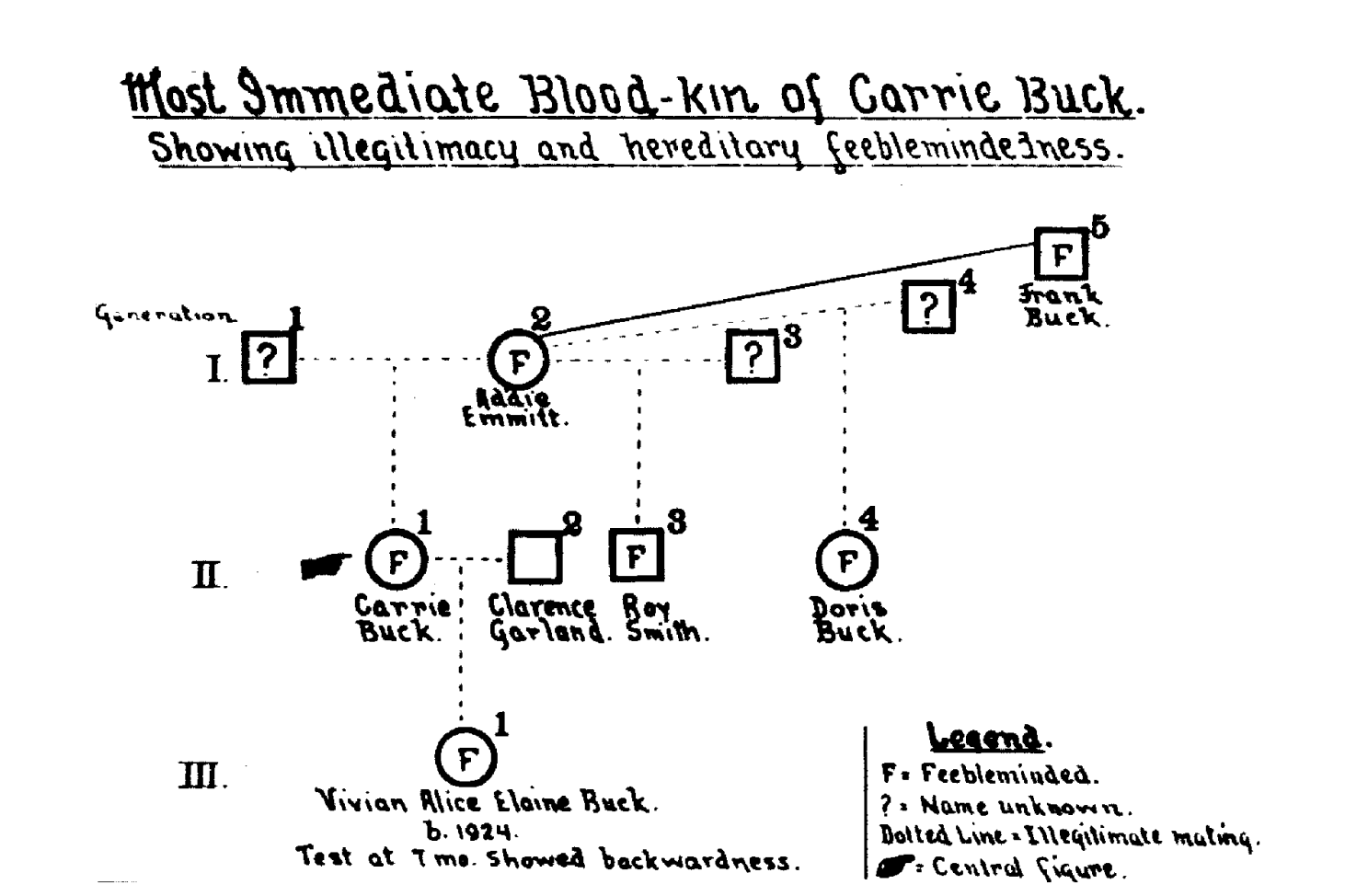
Doctors and lawyers manipulated evidence, labeling Buck’s mother and infant daughter to fit their narrative. Despite Vivian being a typical seven month old baby, she was administered a test that she supposedly failed - labeling her an “imbecile.” The test that was “failed”? Holding a coin in front of the baby to see if she focused on it.
In his testimony to the court, Laughlin described Carrie and her mother as belonging to the group of “shiftless, ignorant, and worthless class of anti-social whites of the South.” In his estimation, people like Carrie and Emma were not just not the right kind of people, they were literally worthless - so worthless that their family line should be wiped out.
10 days later, on May 2, 1927, the Supreme Court decided in favor of the State of Virginia, allowing for the forced sterilization of individuals deemed “feeble-minded”. The Court ruled that such state-mandated sterilization did not violate the Due Process or Equal Protection Clauses of the Fourteenth Amendment, arguing that such actions protected the “welfare of society.” Only one justice dissented.
Chief Justice Oliver Wendell Holmes notoriously justified this decision by stating that “Three generations of imbeciles are enough.”
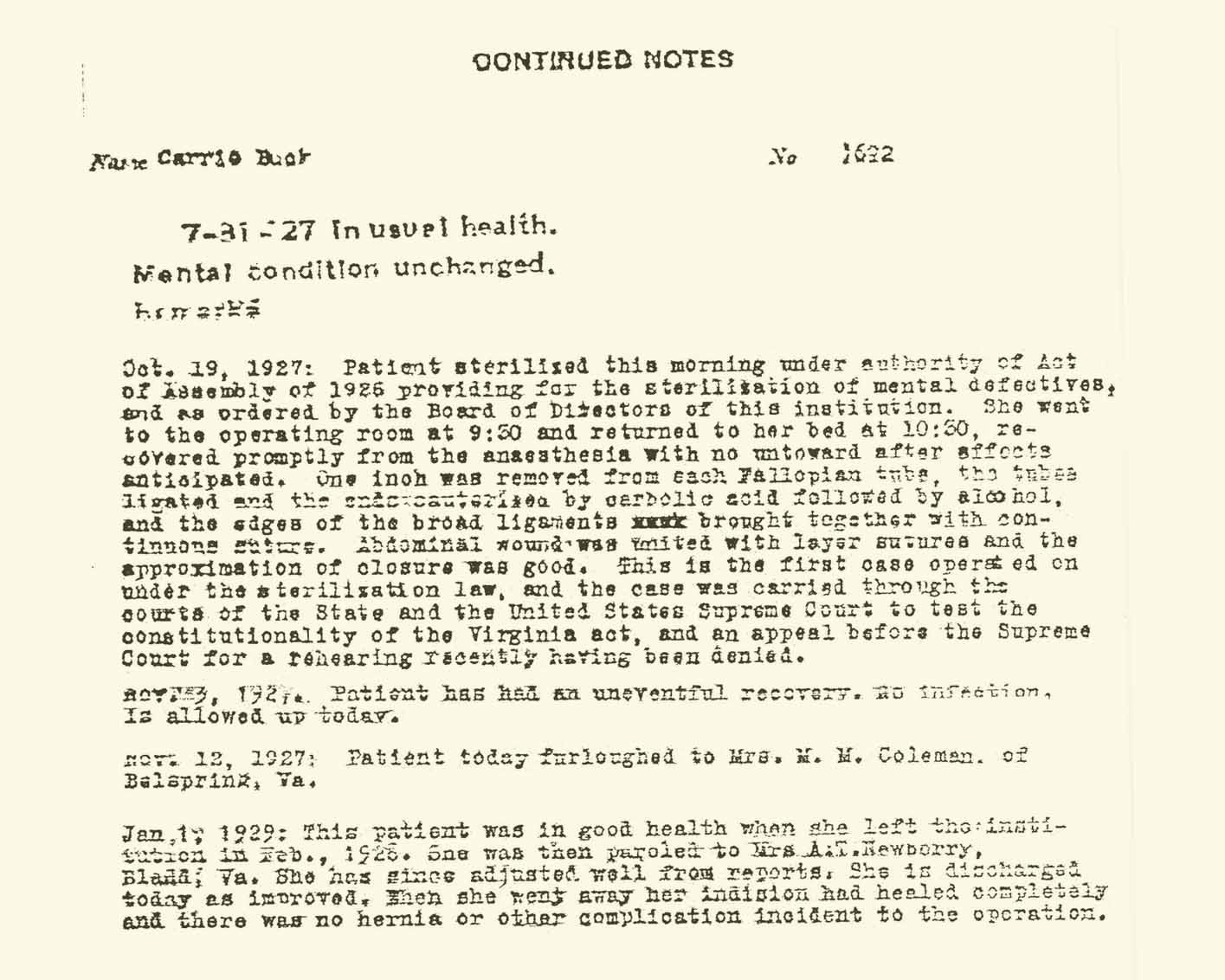
One hundred seventy days later on October 19, 1927, Dr. John Bell, superintendent of the colony, ligated Carrie’s fallopian tubes, removed one inch from each tube, and “cauterized the ends with carbolic acid and alcohol.” He was assisted by nurse Roxie Berry.
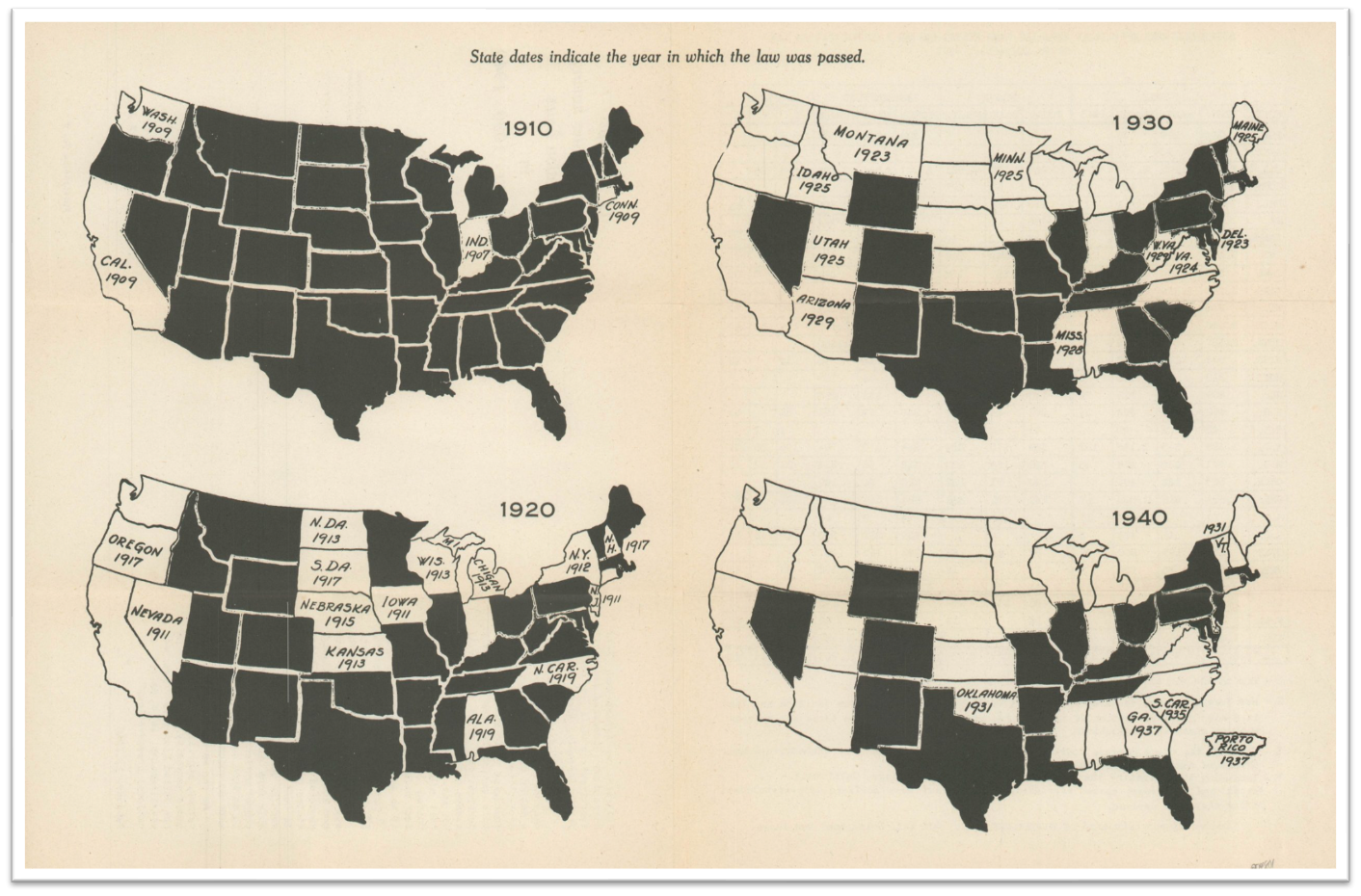
Indiana was the first state to adopt involuntary sterilization statutes in 1907, followed by California, Connecticut, and Washington. While not the first state to codify this grave reproductive injustice, Virginia’s model law solidified the state’s power to limit citizens’ ability to become parents and build families. The legal path clearly articulated in the Buck case, dozens of states followed with their own sterilization laws. Ultimately, hundreds of thousands of people - mostly poor women of color - were robbed of their fertility. Children as young as 10 years old were sterilized.
Virginia didn’t repeal its law until 1974 and didn’t apologize to victims until 2002.
The Dangerous Economic Ideas in Buck v. Bell
While the Holmes’ quote above is the most famous, it’s not the most chilling aspect of his opinion. As Jasmin E. Harris argues, the long lasting effects of Buck v. Bell lie in three less well-remembered sentences in the short opinion:
“We have seen more than once that the public welfare may call upon the best citizens for their lives. It would be strange if it could not call upon those who already sap the strength of the State for these lesser sacrifices, often not felt to be such by those concerned, in order to prevent our being swamped with incompetence. It is better for all the world if, instead of waiting to execute degenerate offspring for crime or to let them starve for their imbecility, society can prevent those who are manifestly unfit from continuing their kind.”
Holmes says the lives of many citizens are simply not worth living. By his logic, they are better never to have existed at all.
The flawed arguments made by Laughlin, Holmes, and countless other eugenicists of the era, was that people with disabilities and people of color are an economically wasteful investment. Kennedy’s testimony doesn’t use the terms “undesireable” or “unfit,” but the connection to the century old court case rang out loud and clear when he called to “improve the risk pool”: ensuring access to care for people with disabilities is expensive.
Rather than working to make care more affordable and accessible, RFK Jr wants people removed from government support programs. The only way “cleaning up the risk pools” lowers prices is if those human beings don’t get care. He may explicitly not say he wants those people to suffer and die, but that is the logica consequence of withdrawing government aid for millions of low income Americans. (Please read, Matthew Cortland’s excellent essay on the hearings for more.)
The Legacy of Buck v. Bell
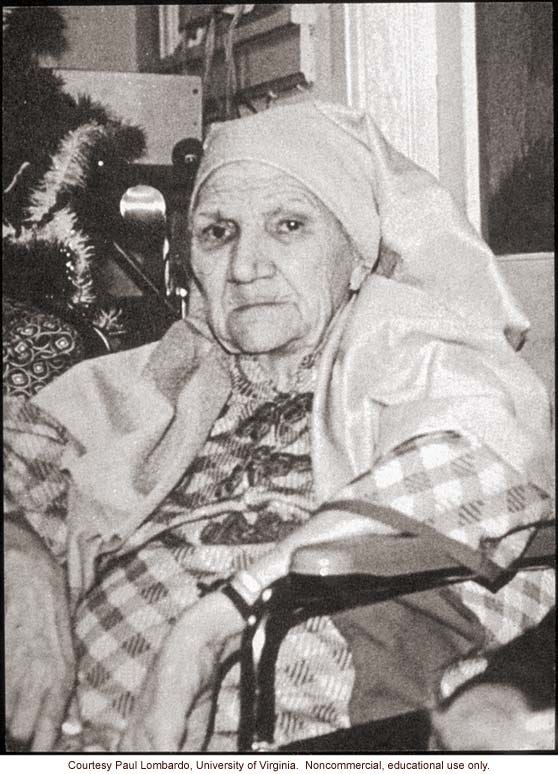
Fifty-six years after her state sanctioned sterilization on January 28, 1983, Carrie Buck Eagle Detamore died at age 76. The last known photo taken of her is from a Christmas pageant at the facility. I wonder if the people who surrounded Carrie at the nursing home reflected on casting her as Mary, Mother of God and Queen of All the Angels. Did they feel it was right and deserved considering the callous injustices she faced early in her life?
Buck v. Bell is a landmark due to its infamy both in America and in Europe. Nazi doctors at the Nuremburg Trials cited the decision in their defense of sterilization “research” and racial purity. The loud calls for eugenics lost their shine in the years following World War II, but the sterilizations continued for decades.
Buck v. Bell has never been overturned. Forced sterilizations haven’t disappeared. The once fervent practice of negative eugenics has fallen out of favor, but scandals related to reproductive coercion have persisted, as evidenced by the treatment of women in both California prisons and immigration detention.
More to Come on Buck v. Bell
Between now and May 2, I’ll share more with you on the eugenic legacy of Buck v. Bell, along with curated lists of books and films to deepen your understanding of this tragic case.
It would not have been ethical to sterilize Carrie for having an intellectual disability.
One thing that does haunt me as a disabled person is that some people only find this case horrifying because she was not actually disabled. I appreciate your footnote that it still would not have been okay to sterilize her if she actually had an intellectual disability.
As someone who can recite the holding, and Oliver Wendell Holmes Jr.’s harsh words 😔, but has forgotten many of the underlying facts, your focus on Carrie Buck as a person, even all these years later, is so valuable, and moving.