

Understanding Tennessee’s Medical Ethics Defense Act
The conscientious objection law further shields physicians who refuse to take care of patients

Sunday, at the top of my Bluesky feed, I saw the following story from journalist Rachel Wells in the Tennessee Banner:
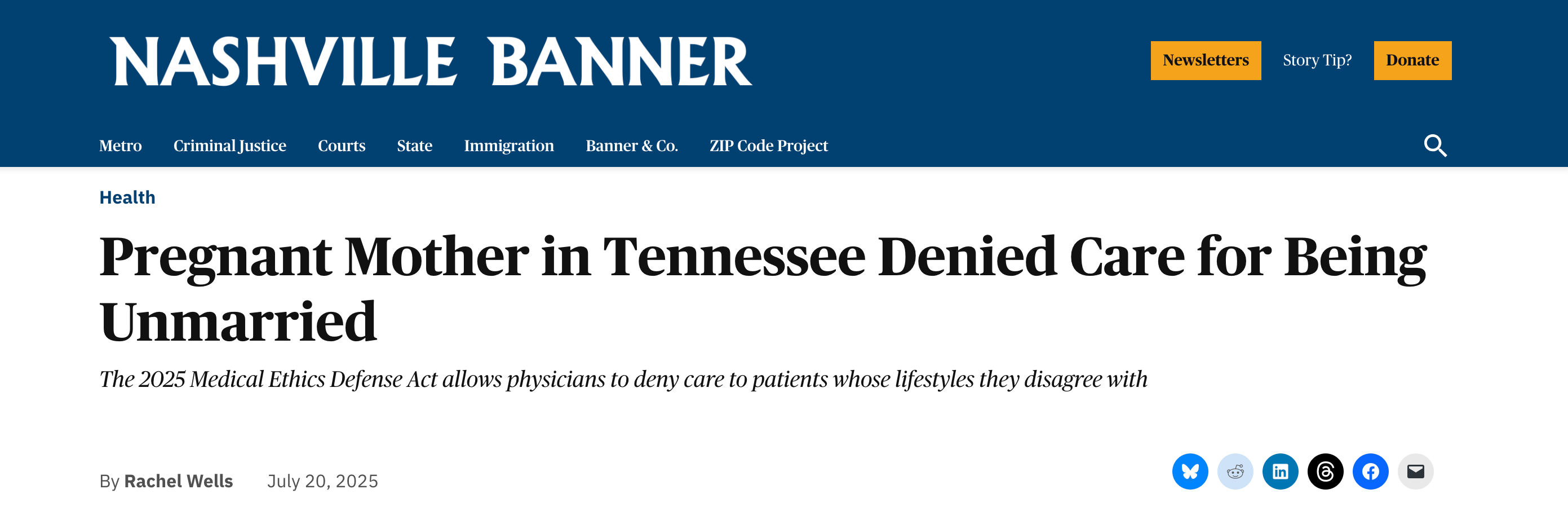
Back in the March 6, 2025, I saw so-called Medical Ethics Defense Act went into effect into effect in Tennessee. As an ethicist, the co-optation of the language of medical ethics specifically by conservative groups is frustrating. Bioethicists are often criticized for being largely liberal, so the conservative legal groups pushing laws like these, attempt to claim their ethical beliefs as the only ones that matter. No doubt, many Tennesseans who saw headlines about the Medical Ethics Defense Act assumed it was something that would protect them, rather than threaten their access to care.
What Is the Medical Ethics Defense Act?
While the Act is couched in the broad language of medical ethics, it focuses on a very niche issue called conscientious objection (also called conscience-based refusals). Since shortly after abortion was legalized with Roe, conscience claims by healthcare workers have been protected under a host of federal laws. Most states have at least one law that protects the conscience claims of healthcare workers, allowing them to refuse to participate in specific aspects of care that violate their core beliefs,
The Tennessee conscientious objection law was written with the assistance of far-right Christian legal advocacy and training group Alliance Defending Freedom (ADF). ADF Senior Counsel Greg Chafuen celebrated the law, claiming it would prevent doctors and nurses from being “targeted for caring for their patients by refraining from harmful and dangerous procedures.”
As a physician who cares for patients and refrains from harming my patients, I find this framing outrageous. Conscientious objection laws are not about protecting patients from harm. In fact, these laws always pose a potential risk to patient safety. When misapplied, patients’ care can be delayed or denied. The federal Emergency Medical Treatment and Labor Act (EMTALA) is all that stands between a clinicians’ religious beliefs and the ability to deny care in a life-threatening situation.
Why Conscience Laws Are Not Patient Protection Laws
The purpose of conscience laws is to protect clinicians from severe moral harms due to acting in ways that contradict their religious, moral, or ethical beliefs - ones that would cause them genuine moral injury. But these are treatments that are both legal and that other clinicians do not object to supporting, offering, referring, or providing. Claiming conscientious objection is to prevent unsafe care is a misapplication of the principles meant to protect clinicians at the expense of patients’s access to otherwise available care.
From Abortion to Anything: Expanding the Boundaries of Refusal
In the ethics community, conscientious objection proponents often assert that cases like the one in Tennessee will never happen. The assumption being that physicians with strong ethical beliefs would only ever use the power to object to provide care under a very narrow set of circumstances. The assumption is that people who utilize conscientious objection are so highly ethical that they would never use such a law to discriminate against a patient. What’s obvious to anyone who deeply questions these laws, is that when a clinician believes their religious beliefs supersede the healthcare needs of patients, this can fuel discrimination.
Tennessee Representative G.A. Hardaway recognized this issue before the bill was passed. In speaking with Nashville Public Radio back in April, he said:
“I would like to believe that it wouldn’t have anything to do with race. But I’ve actually been in a hospital setting and seen a nurse refuse to give service to a Black man for no other reason, other than it was a Black man. So, I’m cautious about this and whether it gives cover for racism to be practiced in the health field.”
- Tennessee Representative G.A. Hardaway
In this case, an obstetrician whose regular practice is to provide prenatal care to patients, has refused to provide care to this specific patient because she does not share their beliefs about marriage. Federal conscientious objection laws were created to protect clinicians and hospitals who refused to participate in abortion and sterilization. The Tennessee law shows how the government has moved towards conscientious absolutism - categorically protecting physicians and nurses who deny patients any care they see fit, based on nothing more than an unshared belief.
For obstetrics practices, if the patient in this news story were to present to a local hospital to deliver and this physician happens to be on-call to deliver babies, then this clinician would be legally obligated to care for the patient regardless of her marital status. But why would this patient ever trust this clinician to ensure she gets access to high-quality care? I wouldn’t.
This means patients will suffer harms from delayed or denied treatment from their healthcare providers related to almost any belief the clinician claims is firmly held. This further burdens patients to not only find a new clinicians who give them appropriate care, they will also would be forced to prove they had been discriminated against in order to seek any legal remedy.
Tennessee Medical Ethics Defense Act (Senate Bill 955/Public Chapter 955)
The Act is broken into three sections on protections (Conscience protections for healthcare workers, whistleblower protections, free speech protections) and one on legal remedy for healthcare workers and organizations that make conscience claims.
Here’s a summary:
Conscience Protections for Healthcare Providers
Healthcare providers cannot be forced to participate in or pay for procedures, treatments, or services that go against their conscience.
The law defines "Conscience" for individuals and institutions:
Individuals: the sincerely held ethical, moral, or religious beliefs or
principles held by a healthcare provider
Institutional entities or corporate bodies: conscience is determined by reference to that entity's or body's governing documents, including ethical, moral, or religious guidelines, directives, mission statements, constitutions, articles of incorporation, bylaws, policies, or regulations
This right:
Applies only to specific procedures—not a blanket exemption from all care.
Doesn’t override existing contractual obligations (e.g., an insurance company still has to pay for services it agreed to cover).
Doesn’t protect providers from lawsuits, criminal charges, or discrimination unless it directly relates to their refusal based on conscience.
Exceptions:
Federal laws still apply (like EMTALA, which requires emergency care).
Religious hospitals and clinics can make employment and staffing decisions based on their beliefs—but only if they openly identify as religious and have internal policies to back that up.
Amendment: These conscience protections do not apply when a patient is in imminent danger of harming themselves or others.
Whistleblower Protections
Healthcare providers are protected from punishment if they:
Report a violation of this law to supervisors, government agencies, or relevant oversight bodies.
Testify, assist, or participate in investigations related to violations of this law.
Providers also can't be punished for disclosing information they reasonably believe shows:
A law or ethical rule was broken.
Patient care is being mismanaged or endangered.
There is a serious public health or safety threat.
Free Speech Protections
State or local governments cannot punish healthcare providers for expressing personal beliefs or opinions, unless:
Their speech directly caused physical harm to a patient they treated in the past three years.
Licensing boards or state agencies can’t deny or revoke certification just because a provider exercised First Amendment rights, as long as they weren’t giving specific medical advice to a patient.
Amendment: These speech protections now apply to all levels of state government, including individual officials acting in their official roles.
Legal Remedies for Healthcare Workers
If a provider’s rights under this law are violated, they can sue in court.
If the court finds a violation, the provider can receive:
A court order to stop the violation (injunctive relief),
An official declaration that their rights were violated (declaratory relief),
Financial damages, attorney fees, and court costs.
A healthcare provider cannot be penalized just because their refusal to participate in a service causes difficulty or cost to others.
What the Tennessee Law Doesn’t Do
The Medical Ethics Defense Act puts very few guardrails around what would be considered a conscience claim. The definition of conscience requires no reasonableness standard, meaning any deeply held belief could be covered.
No Patient Protections
The only discrimination this Act is concerned with is against healthcare workers who deny care. It offers no concerns or remedies for patients who are denied care, even if based in clear discrimination. The Act does not offer any remedy to patients. It assumes that the only violations of the bill will be by employers, not that a person making a conscience claim may apply the law in ways that lead to patient harm.
No Obligation to Give Accurate Information or to Refer
Not only is there no requirement to refer a patient to a provider willing to provide the legally available care, the law specifically defines “participation” to include any aspect of care that might be construed as facilitating the patient getting the care they need. There is no obligation to refer patients for care elsewhere.
The Law Undermines Informed Consent
The Act does not require the clinician to even disclose their objection to providing certain care. Clinicians have no obligation under the law to be honest with patients about their practice and the limitations they will impose on their patients. This means clinicians have no obligation to provide patients with the range of medically safe options for diagnosis and treatment. Clinicians can freely omit any treatments they personally object to. Clinicians will be able to legally withhold vital information - making it impossible for patients to make informed consent choices.
No Referral, No Disclosure: Barriers to Ethical Care
This leaves patients like the one in Wells’ reporting forced to fend for themselves in an already overly complex and burdensome healthcare environment. A patient who is referred to a clinician with an objection are then forced to get another referral to a different physician. If the referring physician has their own objection - which they don’t have to disclose - they may refuse to refer a patient to a willing provider. In a healthcare system where referrals are based on relationships, it’s not far fetched to see this happening - where only far-right Christian clinicians refer to each other, effectively preventing patients from accessing otherwise ethical and legally protected care.
Why This Law Threatens Trust in Healthcare
Laws like the Medical Ethics Defense Act undermine the trust between patients and clinicians. This relationship is already fragile. Codifying unfettered ways for clinicians to avoid informing patients of their healthcare options and refusing to refer to clinicians who are willing to provide regular medical care, this law give healthcare workers an outrageous amount of additional power over patients and their well-being.
Rather that creating a law that would both protect patients from harm and protect the deeply held values of clinicians, the Medical Ethics Defense Act puts patients on the chopping block and prioritizes the beliefs of people who already have immense power to influence health outcomes.